
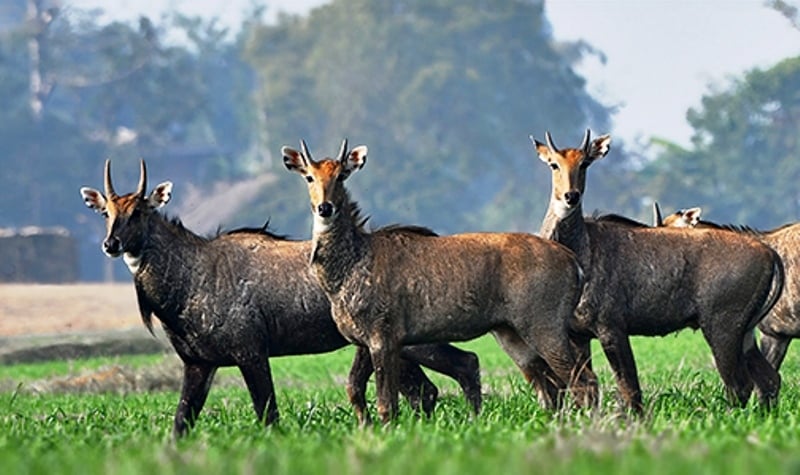
Nilgai-Farmer Conflict: A middle path for Protecting Crops Without Killing Wildlife
Nilgai-Farmer Conflict: A Middle Path for Protecting Crops Without Killing Wildlife
Across many parts of India, farmers are facing a growing crisis. Herds of nilgai regularly enter agricultural fields, damaging standing crops and causing heavy financial losses. For small and marginal farmers, even one night of damage can wipe out months of hard work. Their anger and frustration are real and justified.
At the same time, nilgai are protected wildlife. They are part of our natural ecosystem and hold cultural and ecological value. Killing them raises serious ethical, legal, and environmental concerns. This creates a painful dilemma: how do we protect farmers’ livelihoods without resorting to violence against animals?
Recently, policy responses in some regions have leaned toward allowing the killing of nilgai under certain conditions. While this may appear to be a quick solution, it is important to pause and ask: is this the only option we have? Or have we failed to seriously implement better alternatives?
Understanding the Root of the Problem
The nilgai issue is not simply about animals entering fields. It is a result of deeper, long-term changes:
- Shrinking forests and grazing lands
- Loss of natural predators
- Availability of water and food near farms
- Fragmented landholding patterns
Nilgai are not invading farms by choice; they are adapting to landscapes humans have changed. When crops become the easiest food source, conflict is inevitable.
Why Killing Is a Weak Long-Term Solution
Allowing killing may reduce numbers temporarily, but it does not solve the underlying causes. In fact, it creates new problems:
- It normalizes violence as a management tool
- It risks ecological imbalance
- It creates social and ethical divisions
- It fails to prevent future conflicts as populations recover
Most importantly, it sends a message that when systems fail, animals pay the price, instead of institutions improving their response.
Non-Lethal Solutions Do Exist
Across India and other countries, non-lethal wildlife management methods have shown real results when implemented properly:
- Community-level solar fencing
Low-voltage solar fencing does not kill animals but conditions them to avoid fields. When applied around entire villages or crop clusters (not individual farms), it is highly effective.
- Community-level solar fencing
- Collective crop protection systems
Rotational night guarding, watchtowers, and shared responsibility reduce the burden on individual farmers.
- Collective crop protection systems
- Buffer cropping and crop planning
Planting less attractive crops on field boundaries can reduce entry into main crop areas.
- Buffer cropping and crop planning
- Habitat and water management
Restoring grazing areas and water sources away from farms reduces animal movement toward villages.
- Habitat and water management
- Compensation and insurance mechanisms
Quick and fair compensation builds trust and reduces demands for extreme measures.
- Compensation and insurance mechanisms
The key problem is not the absence of solutions-but the absence of coordinated implementation and political will.
The Missing Middle Path
This issue is often framed as a choice between farmers and animals. That is a false choice. Farmers should not be forced to sacrifice their livelihood, and animals should not be killed because governance failed to plan ahead.
What is needed is a middle path:
- Pilot non-lethal solutions in high-conflict areas
- Fund and monitor them seriously
- Measure outcomes transparently
- Scale what works
Before expanding permissions to kill wildlife, governments should ask:
Have we fully tried and supported alternatives?
A Shared Responsibility
If wildlife is protected by law, then farmers must be protected by policy.
This means:
- Financial support for fencing and deterrents
- Technical guidance from agriculture and forest departments
- Involvement of local panchayats and farmer groups
- Long-term ecological planning, not emergency reactions
Farmers cannot be expected to bear losses alone, just as animals cannot be blamed for human land-use changes.
Conclusion
The nilgai–farmer conflict is not a law-and-order problem; it is a management challenge. Choosing killing as the primary response reflects a failure of imagination, coordination, and commitment.
India has the knowledge, technology, and moral framework to protect both livelihoods and life. What is needed now is the courage to invest in solutions that are humane, scientific, and sustainable
A society is judged not by how quickly it eliminates problems, but by how wisely it resolves them.


